The Three-Second Visual: Choosing Stock Photography That Commands Attention Before the Scroll Moves On

The human visual system makes its first assessment of an image in approximately 13 milliseconds. By the time a user has consciously registered that they are looking at an advertisement, a social post, or a landing page, their brain has already begun deciding whether to engage or continue scrolling. For creative professionals, this neurological reality defines the fundamental challenge of modern visual communication: the image must earn attention before the audience has made a deliberate choice to give it.
This is the terrain of micro-moments—those fractional instants of decision-making that Google's researchers identified over a decade ago and that have only grown more consequential as screen time has increased and content volume has exploded. Understanding how to select stock photography that performs within this compressed window is one of the most practical and high-leverage skills a designer or marketer can develop.
Why Generic Stock Images Fail the Attention Test
Before examining what works, it is worth understanding why so much stock photography fails to register. The answer lies in a phenomenon cognitive scientists refer to as perceptual habituation—the brain's tendency to filter out stimuli it has encountered repeatedly without significant consequence.
When audiences have seen hundreds of variations of the same smiling team around a conference table, the same barista handing over an artfully photographed coffee cup, or the same generic handshake representing a business partnership, those images no longer trigger the novelty response that captures attention. They have been categorized as background noise, processed below the threshold of conscious awareness, and dismissed before the viewer's eyes have fully settled.
This is not a failure of stock photography as a medium. It is a failure of undifferentiated selection. The same libraries that contain those overused archetypes also contain thousands of images that are specific, unexpected, and emotionally precise enough to interrupt the scroll reflex. The creative professional's task is to find them—and to understand why they work.
The Psychology of Visual Specificity
Research in visual attention consistently demonstrates that the brain responds more strongly to images that contain what psychologists call incongruity—a subtle mismatch between expectation and reality that forces the viewer to pause and process. This does not mean that effective images must be bizarre or deliberately provocative. It means that the most arresting photographs tend to contain a level of specificity that generic imagery cannot replicate.
Consider the difference between a stock photograph of a woman running outdoors and a photograph of a woman mid-stride on a rain-slicked city sidewalk, coat open, headphones visible, expression concentrated. The second image is not more dramatic. It is more specific. It contains enough contextual detail to trigger recognition—the viewer's brain begins constructing a narrative, identifying emotional resonance, and registering the image as real rather than staged. That moment of narrative construction is precisely when attention locks.
Micro-moment imagery works on this principle. Rather than depicting a category of human experience at its most generic, it captures a particular instant within that experience—one specific enough to feel observed rather than manufactured.
Identifying High-Value Micro-Moments by Industry
The micro-moments that generate the strongest visual response vary by industry and audience, but several patterns emerge consistently across categories.
In the health and wellness sector, images that capture the instant of physical effort—not the triumphant finish but the difficult middle, the moment of genuine exertion or quiet determination—perform substantially better than polished, aspirational imagery. American consumers in this category have become highly attuned to the difference between authentic effort and performative fitness, and their scroll behavior reflects that discernment.
In financial services and fintech, the most effective micro-moment imagery tends to depict the emotional aftermath of a decision rather than the decision itself. A person reviewing a document with visible relief, a couple discussing something at a kitchen table with an expression of collaborative focus—these images communicate the emotional territory of financial confidence more credibly than abstract imagery of growth charts or stacks of currency.
In the food and beverage industry, the moment just before consumption consistently outperforms the moment of consumption. The hand reaching for a dish, the steam rising from a bowl in a specific quality of morning light, the condensation on a glass photographed at the precise angle that communicates refreshment—these micro-moments activate sensory anticipation in ways that straightforward product photography rarely achieves.
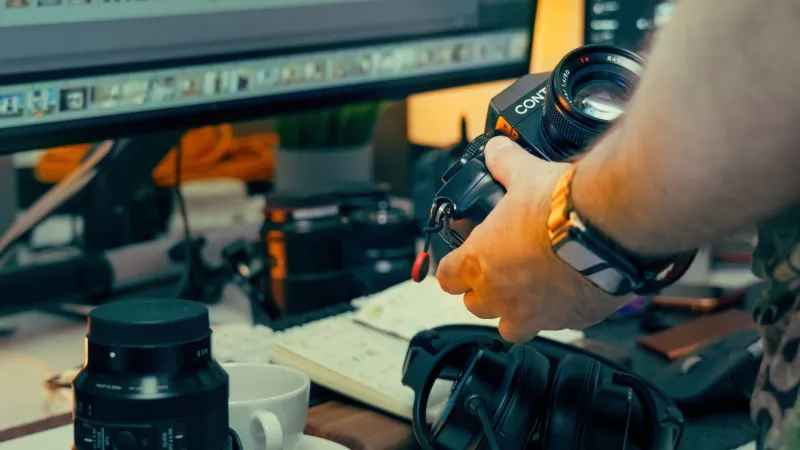
For technology and software brands, images that capture the intersection of focused human attention and a specific task—a designer's hand annotating a physical sketch beside an open laptop, a developer's expression of concentration in a dimly lit workspace—communicate productive engagement more effectively than the ubiquitous overhead flat-lay of devices.
A Framework for Selecting Attention-Capturing Stock Images
Applying micro-moment theory to stock photo selection requires a structured approach. The following framework provides a practical method for evaluating images before committing to them.
Identify the emotional state you are trying to activate. Before searching, define not the subject matter but the feeling the image should produce in the viewer. Curiosity, relief, desire, recognition, urgency—these emotional targets should drive the search before aesthetic preferences do.
Evaluate for narrative momentum. An effective micro-moment image contains an implied story in motion. Something is about to happen, has just happened, or is in the process of happening. Static, posed imagery rarely generates this quality. Look for photographs in which the subject's attention is directed toward something outside the frame, in which motion is implied by composition, or in which environmental details suggest a specific context.
Test for specificity versus genericism. Ask whether the image could plausibly represent dozens of different brands or whether its specific details anchor it to a particular emotional territory. The more specifically an image communicates, the less likely it is to trigger perceptual habituation.
Consider the viewing environment. An image that commands attention on a desktop monitor may lose its impact when compressed to a mobile feed thumbnail. Evaluate stock photos at the actual dimensions in which they will appear, and prioritize images with clear focal points that survive cropping and scaling.
The Relationship Between Authenticity and Attention
Underlying all of these principles is a single observation that the most effective creative professionals consistently report: audiences in 2024 have an exceptionally refined ability to detect the difference between imagery that was captured and imagery that was constructed.
This does not mean that polished, professionally lit stock photography has no place in a visual content strategy. It means that even within a polished aesthetic, the specific details that communicate genuine human presence—an unrehearsed expression, an imperfect environment, a moment of transition rather than resolution—are what separate images that stop the scroll from images that contribute to it.
The three-second window is not won by spectacle. It is won by recognition—the instant in which a viewer sees something specific enough, human enough, and emotionally precise enough to feel, for just a moment, like it was made for them.