Retired Tropes: Seven Visual Formulas American Audiences Have Stopped Believing

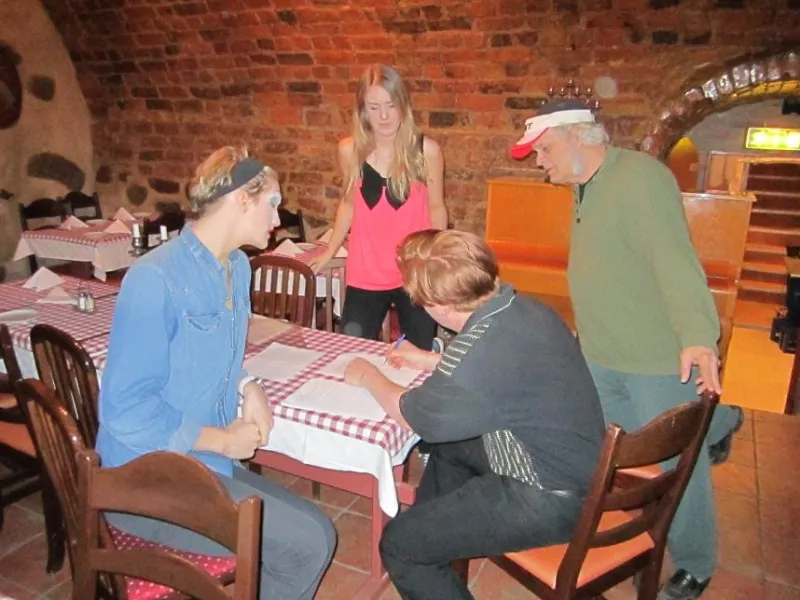
Photo: candid coworkers collaborating authentic office moment, via img.freepik.com
Every visual formula was once a solution. The handshake conveyed partnership; the call-center smile conveyed service; the laptop-in-a-café conveyed modern flexibility. But formulas age, and American audiences — marinated in thousands of branded images a day — have developed a finely tuned immunity to the most overworked among them. Engagement metrics and the tenor of social commentary now point the same direction: certain stock compositions no longer communicate the message. They communicate that a shortcut was taken.
Below are seven tropes that have outlived their usefulness, and directions that carry the same message with the credibility intact.
1. The Business Handshake
Once the universal symbol of deal-making, the staged handshake now reads as a greeting-card artifact. Engagement data on B2B creative consistently shows flat performance for handshake imagery compared with scenes of actual collaborative work.
Instead: Show the work the handshake precedes — two people annotating a document, reviewing a screen, or mid-discussion with visible engagement. Partnership is more convincing when depicted as process, not preamble.
2. The Anonymous Laptop User in a Café
The back-of-the-head MacBook shot has become shorthand for filler content. Viewers register it, file it as generic, and move on.
Instead: If the goal is atmosphere, use environmental detail — a café table from the subject's point of view, hands on a notebook, a window scene. Implied presence outperforms anonymous presence.
3. The Exaggerated Call-Center Smile
The headset-and-blinding-grin composition has become a punchline, and audiences now read the smile itself as insincere. Research on expression perception suggests that overly broad, static grins trigger skepticism rather than warmth.
Instead: Choose service imagery with genuine, moderate expressions — a slight smile, an attentive posture, an agent looking at their screen rather than performing at the camera.
4. The Empty Boardroom Presentation
A presenter gesturing at a chart to a room of nodding colleagues signals corporate theater. It is also, ironically, the least informative way to show expertise.
Instead: Depict the aftermath or the preparation — a whiteboard mid-brainstorm, a sticky-note wall, a laptop with real work on screen. Process imagery signals substance; presentation imagery signals performance.
5. The Thumbs-Up Close-Up
Once a cheerful endorsement, the giant thumbs-up now carries a dated, low-effort connotation — audiences associate it with spam-tier creative.
Instead: Let satisfaction live in context: a customer's relaxed posture after a resolved problem, a shared laugh, a completed task visible on screen. Approval is more persuasive when it is earned on camera.
6. The Rainbow-Colored Group Photo of Perfect Diversity
Audiences are increasingly fluent in spotting diversity staged as set dressing — the precisely balanced, uniformly smiling group arranged like a stock-photo United Nations. Sentiment analysis of social commentary shows this composition now generates eye-rolls precisely among the audiences it aims to include.
Instead: Represent people in specific, unremarkable contexts — a real workflow, a real conversation, individual portraits with individual character. Specificity reads as respect; symmetry reads as marketing.
7. The Leaping Silhouette at Sunset
The jumping-figure-against-the-sky shot, long the default for 'freedom' and 'achievement,' has become visual white noise. It communicates nothing that the copy has not already said.
Instead: Earn the emotion with restraint — a single figure walking away from the camera into a real landscape, or a quiet moment of arrival. Momentum without the literal leap.
The Underlying Principle
What unites these seven tropes is not age but abstraction. Each replaced a specific, observable human moment with a symbolic pose, and audiences have learned to discount symbols. The alternative in every case is the same move: trade the gesture for the context, the performance for the process. Brands that make that trade consistently report the same result — imagery that looks less like stock photography, and works more like it.